
Rural India needs a well-structured waste management system. It is crucial to have one to promote sustainable life in India. and enable rural waste management in India effectively. But why rural India? According to The World Bank report of 2022, 64 % of India’s population lives in rural areas. In this post, we will discuss waste management, the 5 Rs, challenges to waste management, and solutions for the same in rural India, besides some examples.
What is Waste Management?
There are several definitions of waste management on the Internet. UN’s definition is acclaimed worldwide. United Nations Environmental Program(UNEP) defines waste management as
“The total supervision of waste production, handling, processing, storage, and transport from its point of generation to its final acceptable disposal“
What are the Impacts of Improper Waste Disposal on Rural Communities in India?
People often think that once the waste is out of the house, it is out of sight and the system. However, it has far-reaching effects. Poor waste management, from inadequate waste collection systems to a lack of designated disposal areas, causes air pollution and contaminates soil and water.
Health
In India, whether in rural or urban areas, people dispose of their garbage mindlessly in a common dumping area near their homes. When left unattended for several days, the site serves as a breeding ground for several diseases. Disease-causing mosquitoes and flies emerge from it and contaminate our food and utensils. Mosquitoes transfer several diseases like Zika, chikungunya, dengue, and malaria. The waste also emits harmful gasses. These gasses, on inhalation, cause severe respiratory problems.
Insert a graphic of garbage dumped in open fields in the neighbourhood.
Air Pollution
It is well-known that rural communities rely heavily on agriculture, livestock farming, and handicrafts. The agricultural waste includes husks, dry leaves, and failed crops.
So, how do rural communities dispose of the agricultural waste?
The agricultural waste is often left in an open field to rot or is burnt. The burning of residue emits harmful gasses like CO2 NOX, N20, CO, and NH3.
Besides, there is plastic and metals, too. Such gasses further lead to respiratory problems and eye burning, especially for those near the fields.
Water Pollution
Clean water and sanitation holds the sixth position among seventeen sustainable development goals. However, India still needs to provide clean water and sanitation to all. On October 2, 2019, all the villages of India’s 36 states and union territories were declared Open Defecation Free(ODF). However, the National Family Health Survey (NFHS-5) shows that over 25% of the rural households of India defecate in the open.
Disposal of waste and open defecation near water bodies contaminates water. Contaminated water is used for agriculture, bathing, washing, and other daily purposes. People also eat fish and other animal products that live and consume the contaminated water. This can cause several diseases like jaundice, typhoid, and giardiasis.
Insert a graphic of several electronic items lying like a waste.
E-waste
We have seen a significant upsurge in the use of electronic items in the last decade. Mobile phones, radios, refrigerators, and washing machines have also penetrated rural India. However, when such products lose utility, they are thrown in the open. These are called E-Waste. When left openly, it poses grave dangers. Water bodies can dissolve the micro and macro parts. Stray animals may intake it along with other plastic and organic waste. Crops can also absorb the heavy metals. Moreover, on burning, they release harmful fumes.
What are the 5 Rs of Rural Waste Management?
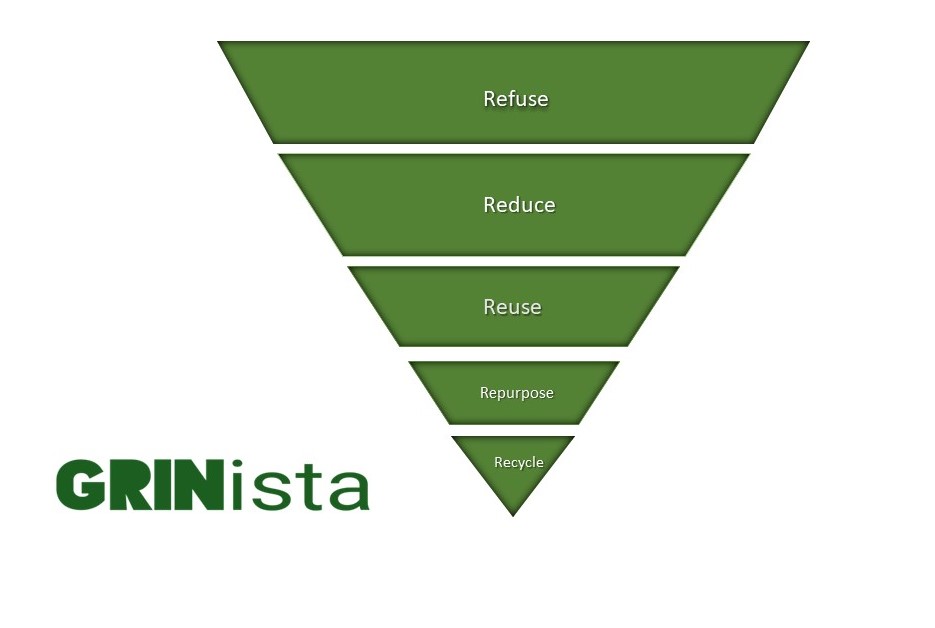
So what are the 5 Rs of Waste management? The 5Rs help a business, a company, and even a household to limit the purchase and production of unnecessary items. The 5 Rs can push a company towards sustainability. In The 5 R’s hierarchy, refuse is the first step, and recycling is the last resort, with reduce, reuse, and repurpose in between.
Refuse
The first step towards a sustainable life is to identify and refuse harmful products to humans, businesses, and the environment. This could be challenging because we are not habitual to refusing items.
Then the question is: How can we Refuse?
Following are some suggestions:
- Refuse the complementary freebies given by companies as a marketing strategy. Freebies might look enticing, but give it a thought while accepting it. Will you use it, or will it go right into a dustbin?
- Imagine you went shopping, and the shopkeeper wrapped your items meticulously. But why? Do you need several layers of covering and box? You can keep that purchased item in a carry bag and head towards home.
- We often have our carry bags and still accept the purchased products in single-use plastic. We can refuse to accept single-use plastic. Sometimes, we need to remember to carry our bags. We can ask for reusable bags or metal containers, if possible, during those times.
Reduce
Reducing means using less. Always think what is the minimum required. Excess add-ons go straight into garbage and pile up in landfills.
Here are some ways to reduce:
- When you print a document, print it double-sided so that less paper is used.
- Shift your business from offline to online mode. Digitizing businesses will reduce the use of paper and cast away all the burden of carrying those documents.
- Lastly, always take your water bottle, coffee mugs, metal straws, and handkerchief to shun and throw items. Carrying your requirements will substantially decrease the carbon footprint.
Reuse
Reuse something you already have instead of buying something new.
Here are some of the stuff you can reuse:
- Throw away the habit of buying new things every time you need them. In contrast, inculcate the virtue of using things until they perish, just like your mom does.
- Reuse shipping boxes and packaging wrappers.
- Stop throwing away plastic and glass containers you get during grocery shopping and start reusing them for storing other stuff.
What is Repurpose?
Repurpose means using something differently. Repurpose requires innovation and craftiness.
Here are a few ideas to repurpose:
- Use small containers as flower pots.
- You can do some DIY stuff using cardboard and metal cans.
- Take those 5 liters of oil jars. Make a few holes in its caps and fill it with water. Now, it could be used for watering plants like sprinklers.
- Usually, after renovation and furniture work, some plywood is always left. You can make a study table and shoe stand out of it.
What is Recycle?
It is the last in the hierarchy of 5R’s. Perhaps you passed up the opportunity to refuse or reduce. Maybe it was not possible to repurpose. Still, you can recycle the products so that others can use them.
Examples of items that can be recycled:
- E-cycling: E-cycling is the recycling of electronic products. In various cities, certain sites are designated by the government to donate such products. Also, many non-profit organizations organize drives for the same.
- Plastics: Plastic is one of the most used products and is equivalently dangerous to the environment. The government and plastic recycling businesses set up many recycling bins for people to recycle plastic waste.
- Instead of carelessly opening a gift wrapper or cardboard box we receive on delivery, we can open it in a mannered way and recycle it later. Also, We all have piled up newspapers, old textbooks, and used notebooks. Recycling the same will make the papers usable again.
What are the Key Challenges of Waste Management in Remote Rural Areas?
In the last few decades, rural India has become more like urban India in terms of consumption habits.
Consumerism, capitalism, and the rise in population have led to the adoption of new products and, thus, more waste generation. According to DDWS-UNICEF, 2008 15,000 to 18,000 million liters of greywater and 0.3 to 0.4 million metric tons of solid waste are produced daily in rural areas.
Waste generated ranges from E-waste to biomedical waste. Rural India has always been deprived of modern waste management methods. Still, it mainly used to be biodegradable trash that had no substantial long-term effects on the environment. This is, however, very different from the present scenario where disposed items include polythene bags, biomedical waste, E-waste, and plastic pollution.
Surprisingly, studies show that the issue in remote areas is a need for proper E-waste disposal systems, not awareness. Unlike urban areas, the availability of land for dumping is relatively low in rural areas. The penetration of hazardous/solid waste management systems doesn’t equally match the penetration of products.
How do We Manage Waste in Rural India?
Rural India chiefly produces organic matter and farm waste. Composting is the best method to manage organic waste. This process is easy and can be used on farms.
A Step-by-Step Guide to Turn Farm Waste into Compost:
Farmland generates farm wastes, and it does not include organic matter and hazardous waste. Farm waste includes dry plants, trees, failed crops, and twigs. Farm waste can be recycled through vermicomposting. Here’s how:
- Create a tank with several holes(10 holes 5cm in diameter each) to facilitate excess water drainage.
- Fill it with farm waste and cow dung in a ratio of 1:1.
- Pour an adequate amount of earthworms on it.
- Keep checking it once a week. Also, make sure the moisture level remains near 40%.
Precaution: Cover the tanks with a shed to prevent high temperatures and rain.
And Viola! In two months, the compost will be ready to use.
Insert this YouTube video here.
How Can We Improve Waste Collection in Rural Communities?
Attracting people to listen to waste collection/disposal awareness programs is fruitless. Therefore, we must be creative to attract the masses and reach programs where people already gather. Here are some ways to improve waste collection/disposal in rural communities.
Nukkad Natak
Nukkad natak is engaging and attractive to viewers. Nukkad Nataks are economical, easy to perform, and leave substantial effects.
Cultural or Religious Events
Rural populations tend to gather at large at any religious or cultural events. Such events allow addressing a more significant number of people.
Gram Panchayats
Local people revere gram panchayats. Their active participation and request of people can make a difference.
How can waste management in rural India create employment?
Waste collection corporations require vast manpower to collect, segregate, and treat wastes. Incentives to entrepreneurs for establishing large-scale composting sites and solid liquid waste treatment plant can create employment.
How Can Waste Management Empower Women in Rural Areas?
According to data, only 41.3% of rural women are employed, against 54.6% of males. 41% of women’s engagement in rural India is promising and shows women are stepping out of their homes to work. This can be further increased by offering jobs in composting businesses. The work is less labor-intensive and can be managed along with household work. Indeed, waste management is promising in empowering women.
Example from ‘JAL THAL MAL’
Retired IAS officer Sopan Joshi, in his book Jal Thal Mal, talks about various ways different regions of India treat waste by themselves. One way is a story from Ladakh. Before the modern system of septic tanks was introduced, the people of Ladakh made manure out of human poop. This requires the households to have an empty room under the washroom where fecal material collects. After pooping, one must throw sand over it so it does not smell foul. Very high temperature is created because of the increased activity of bacteria and other microorganisms, causing all the harmful microorganisms’ death. The produced manure could be used in farming.
Are There Any Successful Waste Recycling Programs in Rural India?
In East Midnapore, West Bengal, the Ramakrishna Mission Lokasiksha Parishad (RMLP) is pioneering a community-driven waste management approach. Partnering with local authorities, they execute the Total Sanitation Campaign (TSC), driven by the motivation of achieving the Nirmal Gram Puraskar (NGP) award.
This innovative approach revolves around active community engagement at every step. It starts with a one-day orientation workshop on Solid and Liquid Waste Management (SLWM), involving a diverse group of stakeholders, including Panchayati Raj Institution (PRI) officials, influential community leaders, and NGOs. Local youth clubs affiliated with the Ramakrishna Mission receive specialized SLWM training, empowering them to drive change within their communities.
Crucially, the model prioritizes awareness-building. Informative materials are distributed in target villages, focusing on TSC and SLWM. Shortly after, cluster-level meetings are held, encouraging community members to participate and engage in discussions. Simultaneously, a door-to-door campaign motivates residents to take action.
A unique aspect is the identification of “first movers” – individuals passionate about change. Volunteers select them based on campaign outcomes, and these individuals spearhead SLWM components, inspiring broader community involvement.
This approach’s success lies in its emphasis on awareness before implementation, active engagement of community figures and residents, empowerment of change-makers, cost-effective technology options, demand-driven implementation, and continuous support and adaptation. East Midnapore has transformed waste management from a challenge into an opportunity for community growth. It’s a shining example of community-driven change for regions worldwide grappling with waste management issues.
Waste management is a crucial step towards sustainability, and to achieve sustainable development goals, it is necessary to start in rural India. Several challenges lie on the way. However, as we have seen, waste management not only cleans the environment but also has several other benefits, like employment and better agricultural production. We can take the first step from our home and bring these ideas into reality.

