
Waste management is no longer just a municipal responsibility or an environmental talking point. It has become a central pillar of sustainability, public health, economic development, and climate resilience. From households to industries, from small institutions to large urban ecosystems, effective waste management is essential to protect natural resources, reduce pollution, and ensure a healthier future.
In a rapidly developing country like India, the way waste is managed directly impacts the quality of life. Increasing consumption, urbanisation, and population growth have made waste management one of the most pressing challenges of our time. Recognising this urgency, GRINista, a UN Millennium Recognised organization, is working towards building structured, practical, and people-centric waste management systems that go beyond collection and disposal.
Why Waste Management Is Critical Across All Sectors
Waste is generated wherever human activity exists. Homes produce organic and packaging waste, offices generate paper and e-waste, retail spaces create plastic and food waste, industries produce hazardous and non-hazardous by-products, and healthcare facilities generate biomedical waste that requires special handling.
This makes waste management a shared responsibility across every sector. Poor waste handling leads to environmental damage, health risks, regulatory non-compliance, and reputational loss. On the other hand, efficient waste management reduces operational costs, improves hygiene, supports sustainability goals, and contributes to a circular economy where materials are reused instead of discarded.
Regardless of the sector, waste management is no longer optional. It is a necessity.
The Waste Management Scenario in India
India generates millions of tonnes of waste annually, yet only a portion of it is scientifically managed. A large share still ends up in open dumps and landfills, contaminating land, water, and air. Organic waste decomposes in landfills and releases methane, a potent greenhouse gas, while plastics and recyclables are lost despite their economic value.
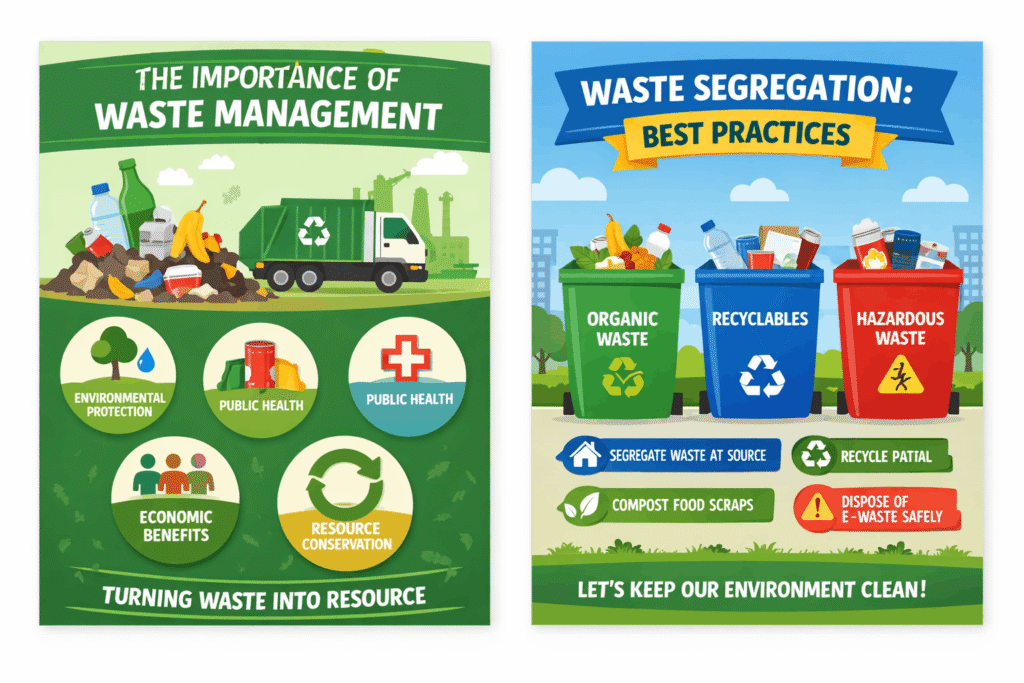
One of the biggest challenges is the lack of segregation at source. When waste is mixed, recycling becomes difficult and expensive. This single gap weakens the entire waste management chain. Addressing this issue requires not just infrastructure, but awareness, participation, and accountability.
Environmental and Health Impacts of Poor Waste Management
Improper waste management has serious consequences for both the environment and public health. Open dumping and burning release toxic pollutants into the air, increasing respiratory illnesses and long-term health risks. Leachate from landfills contaminates groundwater, affecting drinking water sources and agriculture.
Effective waste management reduces these risks by ensuring safe handling, proper treatment, and responsible disposal of waste. It also reduces pressure on natural resources by enabling recycling and composting, which conserve raw materials and reduce emissions.
Clean environments lead to healthier communities, making waste management a critical public health intervention.
The Role of Community Participation
Waste management systems cannot succeed without public participation. Segregation at source, reduction of single-use plastics, and responsible consumption habits are essential for any sustainable model.
When households and institutions actively participate in waste management, the entire system becomes more efficient. Communities that understand the value of segregation and recycling contribute directly to reducing landfill waste and improving recovery rates.
GRINista places strong emphasis on community awareness and behavioural change, understanding that sustainability is driven by people, not just processes.
GRINista’s Approach to Waste Management
GRINista follows a structured and practical approach to waste management that aligns environmental responsibility with social and economic impact. As a UN Millennium Recognised organization, GRINista focuses on solutions that are scalable, inclusive, and measurable.
The core of GRINista’s operations currently revolves around waste collection and segregation, forming the foundation for future recycling integration. By prioritising segregation at source, GRINista ensures that waste remains a resource rather than becoming pollution.
Education and engagement play a central role in GRINista’s model. Through awareness programs, training, and on-ground support, GRINista helps households, businesses, and institutions adopt responsible waste practices that are easy to maintain.
Waste Management as an Economic Opportunity
Waste management is often seen as a cost, but in reality, it is an economic opportunity. Recycling, composting, material recovery, and logistics create employment across multiple levels. Formalising waste management systems improves worker safety, dignity, and income stability.
GRINista supports inclusive waste management by creating opportunities for livelihoods while ensuring ethical and safe working conditions. When waste is managed professionally, it contributes to local economies and strengthens sustainability from the ground up.
Supporting the Circular Economy
A circular economy depends heavily on effective waste management. Instead of following a linear pattern of use and disposal, materials are recovered, reused, and recycled back into the system.
GRINista supports this transition by ensuring that waste streams are properly segregated and directed toward appropriate recovery channels. Organic waste can return to the soil as compost, recyclables can re-enter manufacturing cycles, and residual waste can be minimised.
This approach reduces dependence on virgin resources and supports long-term environmental and economic resilience.
Challenges in Implementing Effective Waste Management
Despite growing awareness, waste management in India continues to face challenges. These include inconsistent segregation practices, infrastructure gaps, limited enforcement, and behavioural resistance. Confirming long-term compliance remains one of the biggest hurdles.
GRINista addresses these challenges through continuous engagement, data tracking, and system improvement. The focus is not just on service delivery, but on building habits, accountability, and trust.
The Road Ahead
As waste generation continues to increase, the importance of waste management will only grow. The future lies in integrated systems that combine technology, community participation, and responsible governance.
GRINista aims to strengthen its recycling integration, expand impact across sectors, and deepen community involvement. The goal is to ensure that waste management becomes a natural part of daily life rather than an afterthought.
Conclusion
Waste management is no longer a background activity. It is central to environmental protection, public health, economic development, and sustainability. Every sector, every household, and every institution has a role to play.
Through its structured approach, community-driven initiatives, and long-term vision, GRINista is helping transform waste management into a powerful tool for sustainable development. By treating waste as a resource and people as partners, GRINista is building systems that protect the planet while empowering communities.
Effective waste management is not just about managing waste. It is about managing our future responsibly.
💡TIP: Measure how much waste you generate using this FREE tool by GRINista

